



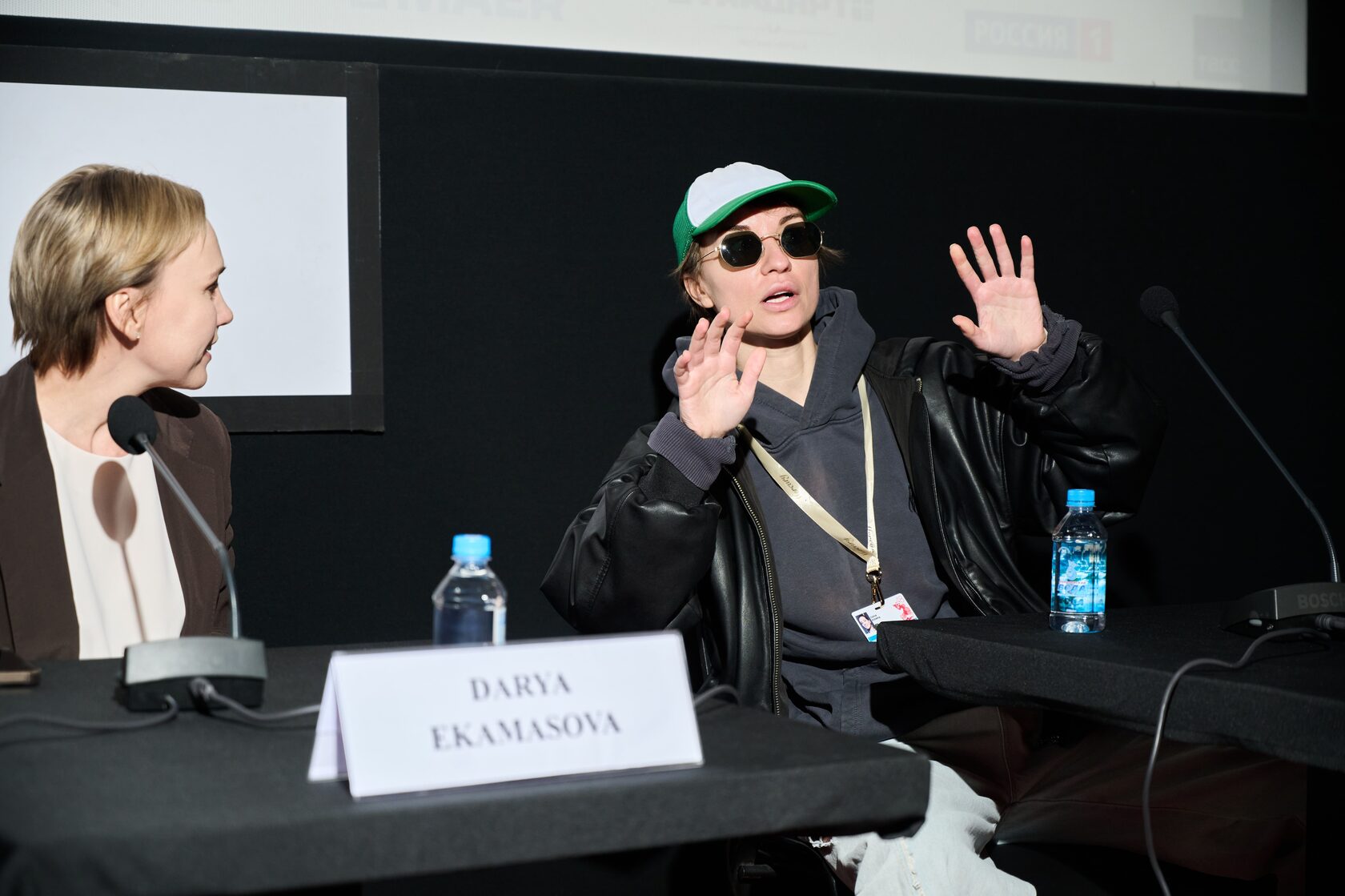
The director Kseniya Zueva, the producers Katerina Mikhailova, the producer and actress Evgeniya Solyanykh, the actress Darya Ekamasova, and the professor and physician Kirill Kostyukov introduced the film Little Taleteller, which is part of the Russian Premiere Competition of the 48th Moscow International Film Festival.
The film tells the story of a married couple, Renata and Eduard. During Renata’s pregnancy, strange changes begin to appear in her behavior, and after the birth of their son, she realizes that she feels no emotional connection to the child. The couple will have to face big challenges.
The film tells the story of a married couple, Renata and Eduard. During Renata’s pregnancy, strange changes begin to appear in her behavior, and after the birth of their son, she realizes that she feels no emotional connection to the child. The couple will have to face big challenges.
Kseniya Zueva: "This is a film about postnatal depression: how to cope with it, what options are there, there are always some options to find a way out of such a situation. We take a very in-depth look at the causes of this depression and overcoming it. In our story, we experience a full range of emotions, flashbacks, and inner thoughts together with the main character. I also have a child, I spend a lot of time with mu child and often see young mothers. They tell me about their childbirth experiences, and their stories scare me to death. The most upsetting is that their loved ones, their mothers-in-law, their husbands, dismiss these experiences. That’s why this film simply had to be made".
Darya Ekamasova: "I spent many hours with the very best doctor, Natalia Klimenchenko. I visited her appointments and saw everything. She gave the inspiration for my character, and, as an actress, I found it very interesting to portray her. It was probably in her office that I first understood what it means to be a woman. Many women with complicated pregnancies came to see Natalia. They were all smiling, but you could tell they had a certain fear, that things might not work well, yet they received the doctor’s great love. We tried to convey the confidence that you can find a way out the darkest pit. You just have to keep moving ahead, believe, and love".
Kirill Kostyukov: "In fact, postnatal depression is quite a relevant issue. Between 10 and 15 percent of women have it, and the causes can be very different. These may include, among other things, medical errors or negligence of doctors. That’s a reality we can’t ignore. So, some very profound issues are being raised here. Indeed, pregnancy is a difficult period in life, because it places an enormous strain on the body, both physically and emotionally. When, during pregnancy and childbirth, certain flashbacks from the past arise, they can trigger these negative mechanisms. This is why perinatal psychologists work to help our patients during pregnancy and after childbirth".
Evgenia Solyanykh: "There is a stigma about the topic of postnatal depression. After meeting Ksyusha and reading this material, I wanted to show through myself and this film that there is no stigma about it. This is our life, and it can be different. Plus, unfortunately, I have my own experience with postnatal depression, and I would like women who will watch this film to try to overcome it".
Darya Ekamasova: "I spent many hours with the very best doctor, Natalia Klimenchenko. I visited her appointments and saw everything. She gave the inspiration for my character, and, as an actress, I found it very interesting to portray her. It was probably in her office that I first understood what it means to be a woman. Many women with complicated pregnancies came to see Natalia. They were all smiling, but you could tell they had a certain fear, that things might not work well, yet they received the doctor’s great love. We tried to convey the confidence that you can find a way out the darkest pit. You just have to keep moving ahead, believe, and love".
Kirill Kostyukov: "In fact, postnatal depression is quite a relevant issue. Between 10 and 15 percent of women have it, and the causes can be very different. These may include, among other things, medical errors or negligence of doctors. That’s a reality we can’t ignore. So, some very profound issues are being raised here. Indeed, pregnancy is a difficult period in life, because it places an enormous strain on the body, both physically and emotionally. When, during pregnancy and childbirth, certain flashbacks from the past arise, they can trigger these negative mechanisms. This is why perinatal psychologists work to help our patients during pregnancy and after childbirth".
Evgenia Solyanykh: "There is a stigma about the topic of postnatal depression. After meeting Ksyusha and reading this material, I wanted to show through myself and this film that there is no stigma about it. This is our life, and it can be different. Plus, unfortunately, I have my own experience with postnatal depression, and I would like women who will watch this film to try to overcome it".